Creating
Scalable Front-Ends with React and Azure
With today's fast-changing digital landscape,
creating scalable and high-performance front-end applications is essential for
any business that wants to deliver out-of-the-box user experiences. As user
requirements and business activities expand, applications need to be scalable
and grow efficiently and transparently. React
and Microsoft Azure combined provide
a strong arsenal to make this happen.
As the need for strong mobile and web
applications continues to rise, businesses are looking toward tried-and-tested
technologies and experienced service providers like RCSMESSAGE—a reliable React
Native app Development Company and source of advanced Microsoft Azure Cloud Services.
This article
discusses:
·
Why
go for React for scalable applications
·
How
to combine React with Azure for scalability
·
Best
practices for combining React and Azure
·
Azure
App Service for front-end hosting
·
Common
challenges and solutions
Why
Use React for Scalable Applications?
React is a mature JavaScript library for
constructing user interfaces from Facebook. It is especially well-suited for
applications that need high performance, modular architecture, and scalability.
Here's why React is best suited to construct
scalable front-ends:
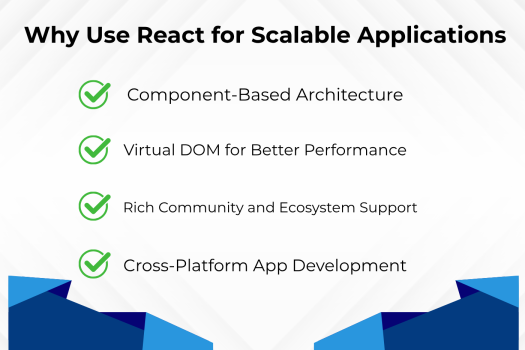
1.
Component-Based Architecture
React's component-based model enables
developers to decompose the UI into smaller, independent pieces. This
encourages cleaner code and simplified maintenance as applications grow.
2.
Virtual DOM for Better Performance
React's virtual DOM boosts rendering and app responsiveness—crucial
for apps that need to cope with rising data loads and user interactions.
3.
Rich Community and Ecosystem Support
Thanks to enormous community support and a
healthy ecosystem of tooling, React developers can find quick solutions and extend
functionality easily.
4.
Cross-Platform App Development
Thanks to React
Native app development, developers are able to use the same codebase for
iOS and Android, promoting efficiency and consistency across platforms.
Most organizations partner with a seasoned React Native app Development Company like
RCSMESSAGE to leverage React to its fullest potential while having scalable
solutions.
How
to Integrate React with Azure for Scalability?
Combining React with Microsoft Azure—a cloud computing leader—brings huge scalability
and dependability to front-end apps. Azure provides flexible deployment
choices, rich development tools, and smooth integrations.
Step-by-Step
Integration Process:
1.
Set Up Your React Application
Begin by building your front-end using React. Packages
such as create-react-app simplify building tools as well as organizing the
project for deployment.
2.
Utilize Azure Static Web Apps or App Services
Azure provides two primary services for React
deployment:
Azure Static Web Apps: Best suited for static front-ends,
featuring native CI/CD integration using GitHub Actions.
Azure App Service: It makes an easy to run a company's
web-site, short-data service, helps to build new mobile apps.
With RCSMESSAGE, a professional Mobile App Development Company in Noida,
companies can deploy React applications easily to the Azure cloud.
3.
Deploy through Azure Portal
The Azure
portal makes deployment easy. Upload your build artifacts or integrate a repository,
set up app settings and publish.
4.
Enable Auto-Scaling
Utilizing Microsoft
Azure Cloud Services set up auto scaling to manage spikes in traffic. This
is important for applications with variable or high user loads.
5.
Integrate Azure APIs & Storage
React applications can talk to cloud storage services and Azure-hosted
backend APIs via REST or GraphQL. Azure provides Azure Blob Storage, Azure
Functions and Cosmos DB for additional backend capability.
Best
Practices for React Applications with Azure
In order to maximize your React + Azure stack, observe these best practices for scalability,
performance and security:
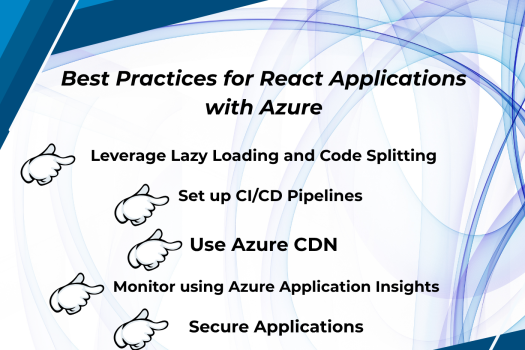
1.
Leverage Lazy Loading and Code Splitting
Split up React components and load them
dynamically. This helps decrease initial load times and enhances user
experience—particularly for larger apps.
2.
Set up CI/CD Pipelines
Employ GitHub Actions or Azure DevOps to
automate deployment. Continuous integration keeps your React app in sync with
minimal human intervention.
3.
Use Azure CDN
Host assets through Azure Content Delivery Network (CDN) to get high loading speeds worldwide.
4.
Monitor using Azure Application Insights
This feature assists in monitoring performance
issues, user behavior and errors enabling teams to resolve bottlenecks ahead of
time.
5.
Secure Applications
Verify authentication and role-based access via
Azure Active Directory or third-party identity providers.
By riding best practices via a trusted App Development Company like RCSMESSAGE, companies can guarantee
high scalability and performance.
Azure
App Service for Front-End Hosting
Azure App Service is a PaaS (Platform as a Service) solution that streamlines hosting web and
mobile applications.
Key
Benefits:
·
Managed Infrastructure: Azure will handle patching,
scaling, and maintenance.
·
Built-in Scaling: Auto-scale on metrics such as CPU
usage or traffic bursts.
·
Deployment Slots: Quickly test new versions prior to
pushing them live.
·
Integration with Azure DevOps: Automate deployment pipelines for
React applications.
·
Global Reach: Deploy in data centers around
regions for improved latency.
Companies seeking scalable, high-performing
hosting rely on Azure App Service
and prefer experienced partners like RCSMESSAGE, a top Mobile App Development Company in India, to handle end-to-end
deployments.
Common
Challenges in React and Azure
Though React and Azure are a strong
combination, developers usually face issues during implementation. Below are
some of the common problems and how to overcome them:
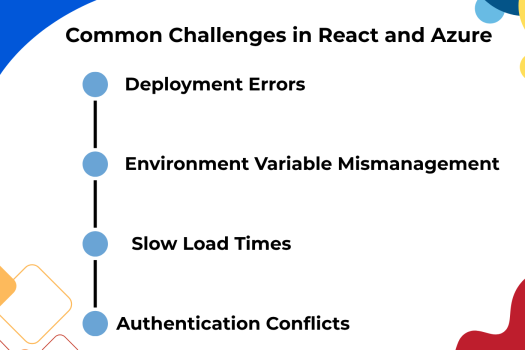
1.
Deployment Errors
Problem: Deployment fails due to improper
build paths or static file configurations.
Solution: Correctly reference your `build`
folder in the Azure pipeline or App Service configuration.
2.
Environment Variable Mismanagement
Problem: Inadequate environment variable
injection during production deployment.
Solution: Implement `.env.production` files
for your React application and set the same in the Azure portal under Application Settings.
3.
Slow Load Times
Problem: Heavy JavaScript bundles in React
apps lead to longer load times.
Fix: Apply code-splitting, image
compression, and Azure CDN to enable faster asset delivery.
4.
Authentication Conflicts
Problem: Authentication configured
incorrectly through third-party libraries or Azure AD.
Fix: Refer to Microsoft's documentation
to set up Azure AD with React or utilize a React Native app development
services service like RCSMESSAGE for quick setup.
5.
Scaling Bottlenecks
Problem: Static hosting isn't capable of
serving backend logic or dynamic rendering.
Solution: Utilize Azure Functions for Serverless or Azure App Service for full-fledged hosting.
Why RCSMESSAGE is Your Best Choice as a Development Partner?
While developing scalable applications using
React and Azure, it is crucial to partner with an expert team. RCSMESSAGE, an
established Mobile App Development Company in Noida, provides an end-to-end
suite of development services specific to your growth.
What
Sets RCSMESSAGE Apart?
Specialization
in React and React Native
As a top React Native app Development Company,
RCSMESSAGE develops high-performance scalable cross-platform apps.
Azure
Integration Experts
With extensive expertise in Microsoft Azure
Cloud Services, RCSMESSAGE provides maximum uptime, performance, and security
to your applications.
Full-Cycle
Development
From planning to deployment and tracking,
RCSMESSAGE takes care of all stages of app development with accuracy.
International
Client Base
Relied upon by enterprises and startups from
various industries, they provide mobile app development in India as well as
overseas with affordable pricing and dependable assistance.
Custom
Solutions
Whether static web hosting or dynamic
deployment of apps, API integrations or anything else RCSMESSAGE provides
customized solutions as per your specific requirements.
By partnering with RCSMESSAGE, companies have
access to an industry-leading App
Development Company that understands how to merge React and Azure for scale
and high performance.
Conclusion
Building scalable front-ends is no longer
optional—it's a necessity. React offers modular, efficient development, while Microsoft
Azure ensures that your applications are secure, globally available and ready
to scale.
Whether you’re a startup, mid-size company, or
large enterprise, leveraging these technologies together can significantly
boost your digital capabilities.
Yet, victory in this arena is all about
expertise. Henceforth, companies join hands with RCSMESSAGE, a highly-rated
React Native app Development Company and specialist in cloud services and mobile
app development in India.